If you've been using HubSpot for marketing analytics, you've probably noticed something: it's incredibly powerful, but it's also complicated, expensive, and often overkill if you just need solid attribution tracking without the full CRM suite.
Here's the reality—HubSpot Marketing Hub starts at $800/month for the Professional tier (where you actually get meaningful attribution features), and jumps to $3,600/month for Enterprise. For many agencies and growing brands, that's simply not sustainable, especially when you're primarily focused on understanding which marketing campaigns actually drive revenue.
The good news? Several alternatives have emerged that deliver robust marketing attribution without requiring you to take out a second mortgage. Some focus specifically on attribution and analytics, offering deeper insights for a fraction of the cost. Others provide the multi-touch tracking capabilities that HubSpot charges enterprise prices for.
Let's explore five legitimate HubSpot alternatives that deserve your attention in 2025, what makes each one unique, and which might be the right fit for your marketing stack.
What to Look for in a HubSpot Marketing Analytics Alternative
Before we dive into specific tools, let's establish what actually matters when you're evaluating alternatives.
Attribution capabilities matter most. Can the tool track your complete customer journey across multiple touchpoints? Does it handle both online and offline conversions? Can you see which campaigns influenced sales, not just which got the last click?
Pricing transparency is non-negotiable. If a tool makes you book a demo just to see pricing, that's usually a red flag that costs will be higher than you'd like. The best alternatives offer clear, predictable pricing that scales with your business.
Integration ecosystem defines usability. Your analytics tool needs to play nicely with the platforms you're actually using—whether that's Shopify, Instagram, LinkedIn, your email platform, or your CRM. The more native integrations available, the less manual data wrangling you'll need to do.
Ease of use separates good from great. HubSpot is notoriously complex with a steep learning curve. A good alternative should give you insights faster, with less training required. If your team needs a week of onboarding to understand basic reports, something's wrong.
Support and documentation can save you hours. When you hit a snag at 4 PM trying to figure out why your attribution model isn't capturing conversions correctly, responsive support matters. Look for tools with strong documentation, active communities, and accessible support teams.
Now, let's look at five alternatives that check these boxes.
1. Influmetrix – Purpose-Built for Multi-Channel Attribution
If your primary frustration with HubSpot is that it doesn't effectively track influencer campaigns, event marketing, organic social posts, and content attribution, Influmetrix was literally built to solve this problem.
What Makes Influmetrix Different
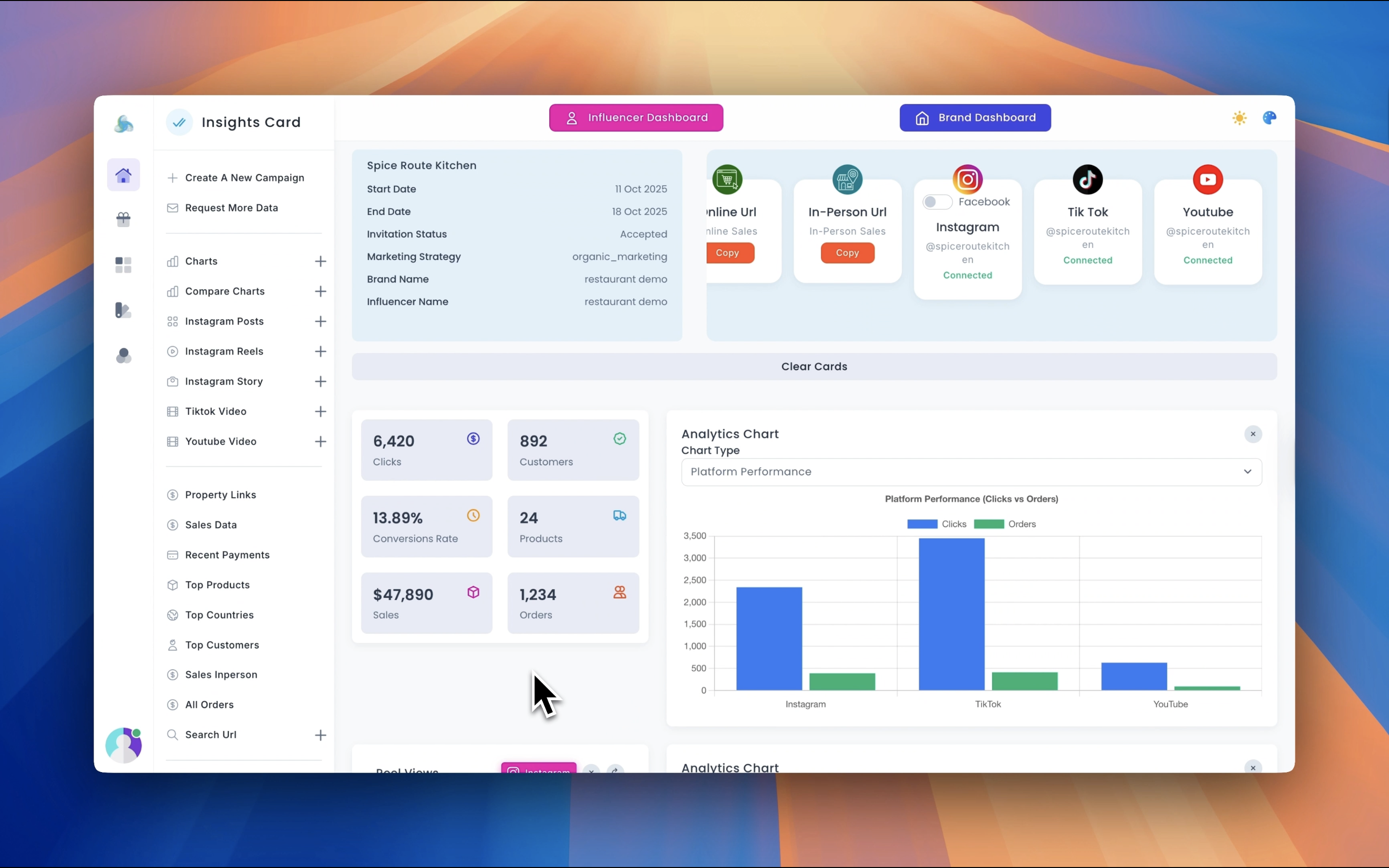
Unlike HubSpot which started as a CRM and added marketing analytics later, Influmetrix was designed from day one for modern marketing attribution. It tracks the channels that today's agencies and brands actually use, influencer partnerships, in-person events, organic social content, blog posts, and traditional digital campaigns, all in one unified platform.
The standout feature is the AI marketing assistant that doesn't just show you data, but tells you what to do with it. Instead of staring at dashboards wondering "what does this mean?", you get plain-English insights like "Your LinkedIn posts generate leads at 3x the rate of Instagram, but Instagram leads convert 40% better, consider increasing budget to both."
For agencies, the multi-client dashboard system is game-changing. You can manage attribution for dozens of clients from one interface, generate white-label reports, and give clients direct access to their own dashboards without them seeing other accounts.
Pricing That Makes Sense
This is where Influmetrix really differentiates from HubSpot. Instead of starting at $800/month, pricing begins at $49/month for individual creators and small brands, $149/month for growing businesses running multiple campaigns, and $349/month for agencies managing multiple clients.
Compare that to HubSpot's $800/month starting point, and the value becomes obvious. You're getting purpose-built attribution features without paying for CRM functionality you might not need.
Best For
Agencies managing influencer and content marketing campaigns for multiple clients, brands running multi-channel marketing, marketing teams that need to prove ROI across organic and paid channels, and anyone frustrated by Google Analytics 4's blind spots around impression-based marketing.
Potential Drawbacks
If you need a full marketing automation suite with email sequences, landing page builders, and lead scoring built-in, Influmetrix focuses specifically on attribution rather than being an all-in-one platform. It integrates with your existing email and automation tools rather than replacing them.
2. Ruler Analytics – Closed-Loop Revenue Attribution
Ruler Analytics has carved out a strong reputation for connecting marketing touchpoints directly to revenue, which is exactly what most marketers struggle with in HubSpot's attribution reports.
What Ruler Does Well
The platform excels at closed-loop attribution, meaning it tracks the complete journey from first anonymous website visit through multiple touchpoints all the way to closed revenue in your CRM. This gives you a clear picture of which campaigns generate actual money, not just leads that sit in your pipeline forever.
Ruler's phone call tracking is particularly strong. If your business generates leads through phone calls (which many B2B and local businesses do), Ruler captures those conversions and attributes them back to the marketing source that drove the call. HubSpot offers this, but it's buried in higher-tier plans.
The tool also handles offline conversions elegantly, letting you import revenue data from in-store purchases, trade show leads, or any other offline channel, then matching those conversions back to online marketing touchpoints.
Pricing Structure
Ruler starts at $199/month for up to 50,000 website visitors, which includes multi-touch attribution models, revenue tracking, and basic integrations. This scales up based on traffic volume, but remains significantly more affordable than HubSpot for most mid-market companies.
Best For
B2B companies with longer sales cycles who need to prove marketing's impact on closed revenue, businesses that generate significant leads through phone calls, and marketing teams that run both online and offline campaigns requiring unified attribution.
Potential Drawbacks
The interface isn't as polished as some competitors, and the setup can be technical if you're implementing advanced attribution models. You'll likely need some technical knowledge on your team or should plan for implementation support.
3. Dreamdata – B2B Revenue Attribution for Complex Sales
Dreamdata focuses exclusively on B2B revenue attribution, making it ideal for companies with complex, multi-stakeholder sales processes that HubSpot's standard attribution often oversimplifies.
Why B2B Companies Love Dreamdata
The platform was built specifically for B2B marketing, where buying committees, long sales cycles, and account-based marketing make attribution exceptionally complex. Dreamdata handles this by tracking at the account level rather than just the contact level, showing you which marketing efforts influenced the entire buying committee.
It automatically builds customer journey maps showing every touchpoint an account experienced before closing, from the first anonymous website visit through content downloads, demo requests, and multiple stakeholder interactions. This level of visibility is difficult to achieve in HubSpot without significant custom configuration.
The tool integrates directly with major CRMs and marketing platforms, automatically pulling in data from your ad platforms, website, sales calls, and more to create a unified attribution picture.
Pricing Approach
Dreamdata operates on custom pricing based on your data volume and needs, which unfortunately means you need to talk to sales. Based on public information and user reports, expect pricing to start around $1,000/month for small teams, rising to several thousand for mid-market companies. Still potentially cheaper than HubSpot Enterprise, but not dramatically so.
Best For
B2B SaaS companies, enterprise software sellers, and any business where multiple stakeholders influence purchase decisions. If your sales cycle is measured in months and involves numerous touchpoints across different departments, Dreamdata handles this complexity better than most alternatives.
Potential Drawbacks
The "contact us for pricing" model is frustrating, and based on user feedback, the sales process can be lengthy. The tool is powerful but complex, requiring substantial time investment to configure properly and interpret results.
4. Segment – Customer Data Platform with Attribution Capabilities
Segment takes a different approach than traditional marketing analytics tools. Rather than being an analytics platform itself, it's a customer data infrastructure that unifies all your data sources and sends clean, organized data to your analytics tools.
The Segment Philosophy
Think of Segment as the data layer that sits between your marketing channels and your analytics tools. Instead of each platform (your website, mobile app, email tool, ad platforms) sending data in different formats to different destinations, Segment collects everything, cleans it, and distributes it consistently.
This approach solves one of HubSpot's most painful problems: integrating data from sources HubSpot doesn't natively support. With Segment, you can collect data from literally hundreds of sources and send it wherever you need it—your data warehouse, Google Analytics, your CRM, and specialized analytics tools simultaneously.
For attribution specifically, Segment provides the foundation for building custom attribution models. The platform tracks user identity across devices and channels, maintaining consistent user profiles as people move between your website, mobile app, and other touchpoints.
Pricing Reality
Segment offers a free tier for up to 1,000 monthly visitors, then moves to their Team plan at $120/month for up to 10,000 monthly tracked users. For serious usage, you're looking at custom Enterprise pricing, which can run several thousand per month depending on data volume.
Best For
Technical teams that want to build custom attribution models, companies with complex data needs spanning multiple platforms and destinations, and businesses that need a single source of truth for customer data across their entire stack.
Potential Drawbacks
Segment is infrastructure, not an out-of-the-box analytics solution. You'll still need analytics tools on top of Segment to actually visualize and interpret your attribution data. It's also quite technical—non-technical marketers will struggle without developer support.
5. Mixpanel – Product Analytics with Marketing Attribution
Mixpanel is primarily known as a product analytics platform, but its event-based tracking model makes it surprisingly effective for marketing attribution, especially for digital-first businesses.
What Mixpanel Brings to Attribution
The platform's strength is granular event tracking. Instead of just knowing someone visited your website, you can track specific actions: which features they explored, which content they engaged with, what paths led to conversion. This level of detail helps you understand not just which marketing channels drive traffic, but which drive quality users who actually engage with your product.
For SaaS companies and app-based businesses, this is invaluable. You can see which marketing campaigns bring users who actually activate, stick around, and eventually convert to paid plans—not just which campaigns drive the most signups.
Mixpanel's cohort analysis is particularly powerful. You can group users based on acquisition source, then track how each cohort behaves over time. This reveals whether users from paid ads have better retention than organic social traffic, or whether email campaign users convert faster than content marketing leads.
Pricing Model
Mixpanel offers a generous free tier supporting up to 20 million events per month, making it viable for startups and small businesses. Paid plans start at $20/month for the Growth tier, scaling based on event volume. For serious business usage, expect to pay several hundred to a few thousand per month depending on your data volume.
Best For
SaaS companies, mobile apps, and digital products where user behavior matters as much as acquisition source. If you need to understand the quality of users from different marketing channels, not just quantity, Mixpanel excels.
Potential Drawbacks
The event-based model requires thoughtful implementation. You need to define and track the right events, which takes planning and often developer involvement. It's also not ideal for traditional marketing attribution if you're primarily focused on website conversions rather than in-app behavior.
Making Your Decision: Which Alternative Fits Your Needs?
The right HubSpot alternative depends entirely on what you actually need from your marketing analytics stack.
Choose Influmetrix if you're an agency or brand primarily focused on proving ROI across influencer marketing, content marketing, events, and organic social. The transparent pricing, multi-client capabilities, and AI-powered insights make it the most straightforward option for modern multi-channel attribution without the HubSpot complexity and cost.
Choose Ruler Analytics if phone call conversions are a significant part of your business and you need rock-solid closed-loop attribution connecting marketing spend directly to revenue. The offline conversion handling is excellent for businesses that blend online and offline marketing.
Choose Dreamdata if you're a B2B company with complex, multi-stakeholder sales processes and you need account-level attribution that shows how marketing influences entire buying committees. The B2B-specific features justify the higher price point if your sales cycles are measured in months.
Choose Segment if you have technical resources and need a unified customer data infrastructure that feeds multiple analytics and marketing tools. This is the right choice for companies building custom attribution models or dealing with complex data integration challenges across many platforms.
Choose Mixpanel if you're a SaaS or app-based business that cares deeply about user behavior and product engagement, not just acquisition metrics. The event-based model reveals user quality in ways traditional attribution tools miss.
The Honest Truth About Leaving HubSpot
Let's address the elephant in the room: switching from HubSpot isn't trivial, especially if you're using it for more than just marketing analytics.
If HubSpot is your CRM, email marketing platform, landing page builder, and analytics tool all in one, migrating everything at once would be disruptive. But here's what many companies are discovering: you don't have to migrate everything simultaneously.
Many businesses keep HubSpot for what it does well (CRM, email automation, landing pages) while using a specialized attribution tool for what HubSpot struggles with—accurately tracking multi-touch customer journeys across channels it doesn't natively integrate with well.
This hybrid approach often delivers better results at lower total cost than paying for HubSpot Enterprise just to get advanced attribution features. You maintain the HubSpot functionality your team relies on while getting superior attribution insights from a purpose-built tool.
The other reality: HubSpot's complexity means many teams only use a fraction of its capabilities. If you're paying $800-$3,600/month but primarily using it for marketing analytics and basic campaign tracking, you're almost certainly overpaying. Switching to a specialized attribution tool could cut your costs by 70-90% while actually improving the insights you get.
Questions to Ask Before You Switch
Before committing to any HubSpot alternative, work through these questions with your team:
What specific HubSpot features do we actually use regularly? Document this honestly. You might find you're paying for far more than you need.
What attribution gaps are we trying to fill? Be specific about what's missing. Is it influencer tracking? Offline attribution? Multi-touch models? Account-level B2B attribution? Different tools excel at different things.
What's our technical capacity for implementation? Some alternatives require significant setup and ongoing technical management. If you don't have developers available, prioritize tools with simpler implementation and better support.
How important is having everything in one platform versus best-of-breed tools? There's a real tradeoff between all-in-one convenience and specialized excellence. Neither answer is wrong, but be honest about your team's preferences.
What's our realistic budget for marketing analytics? Include not just software costs but implementation, training, and ongoing management. Sometimes a higher monthly cost is worth it if it reduces the human hours required.
Final Thoughts: The Marketing Analytics Landscape Has Evolved
Five years ago, HubSpot was one of the few comprehensive options for marketing analytics, especially for companies that didn't have enterprise budgets or technical teams to build custom solutions.
Today, the landscape has matured dramatically. Specialized tools like Influmetrix, Ruler, and Dreamdata have emerged that do attribution better than HubSpot at a fraction of the price. Data infrastructure tools like Segment enable custom solutions that weren't viable for mid-market companies before. Even product analytics tools like Mixpanel have evolved to handle marketing attribution use cases effectively.
For many businesses, HubSpot has become the expensive, complex choice rather than the obvious default. The platform still has its place—particularly for companies that value having marketing, sales, and service tools unified under one roof. But if attribution is your primary need, better alternatives now exist.
The question isn't whether you should leave HubSpot entirely. It's whether you're paying for capabilities you don't fully use when specialized tools could deliver better attribution insights at lower cost.
Take an honest inventory of what you're actually getting from HubSpot's marketing analytics. If the answer is "less than we're paying for," exploring these alternatives isn't just smart—it's overdue.
Ready to Explore Better Attribution?
Most of these platforms offer free trials or demos, making it low-risk to test whether an alternative might work better for your specific needs.
Influmetrix offers a 30-day free trial with no credit card required, letting you connect your marketing channels and see the full attribution picture within minutes. If you're primarily focused on proving ROI across influencer marketing, events, and content marketing, it's worth experiencing how much clearer attribution becomes when you use a tool built specifically for these channels.
The marketing analytics landscape has evolved significantly. Make sure your tools have evolved with it.
Frequently Asked Questions
Can I use these tools alongside HubSpot instead of replacing it?
Absolutely. Many companies keep HubSpot for CRM and email automation while using specialized attribution tools for better marketing insights. Most alternatives integrate with HubSpot, so you can maintain your existing workflows while getting improved attribution data.
Will I lose historical data if I switch from HubSpot?
Most platforms can import historical data or run alongside HubSpot during a transition period. The specifics depend on which alternative you choose, but data loss isn't usually an issue if you plan the migration properly.
How long does it take to implement these alternatives?
It varies significantly. Influmetrix and Ruler can typically be set up in hours or days with basic integrations working immediately. Segment and Dreamdata often require weeks of implementation to configure properly. Mixpanel falls somewhere in the middle.
Do these alternatives offer the same reporting capabilities as HubSpot?
They offer different reporting focused on attribution specifically. You get better attribution insights but may not get all of HubSpot's campaign management and general marketing reports. Evaluate whether the tradeoff makes sense for your needs.
What if I'm locked into a HubSpot annual contract?
Most alternatives can run alongside HubSpot during your contract period, letting you compare results. Many teams find that using both tools temporarily helps them understand which solution delivers better insights before fully committing to a switch.
Are these tools suitable for small businesses or just enterprises?
All five alternatives work for different business sizes. Influmetrix and Mixpanel explicitly target smaller businesses with affordable entry points. Ruler and Dreamdata are more mid-market focused. Segment serves everyone from startups to enterprises depending on which tier you choose.
Looking for attribution that actually tracks your influencer partnerships, events, and content marketing? Start your free 30-day trial of Influmetrix and see your complete marketing picture within minutes—no credit card required.