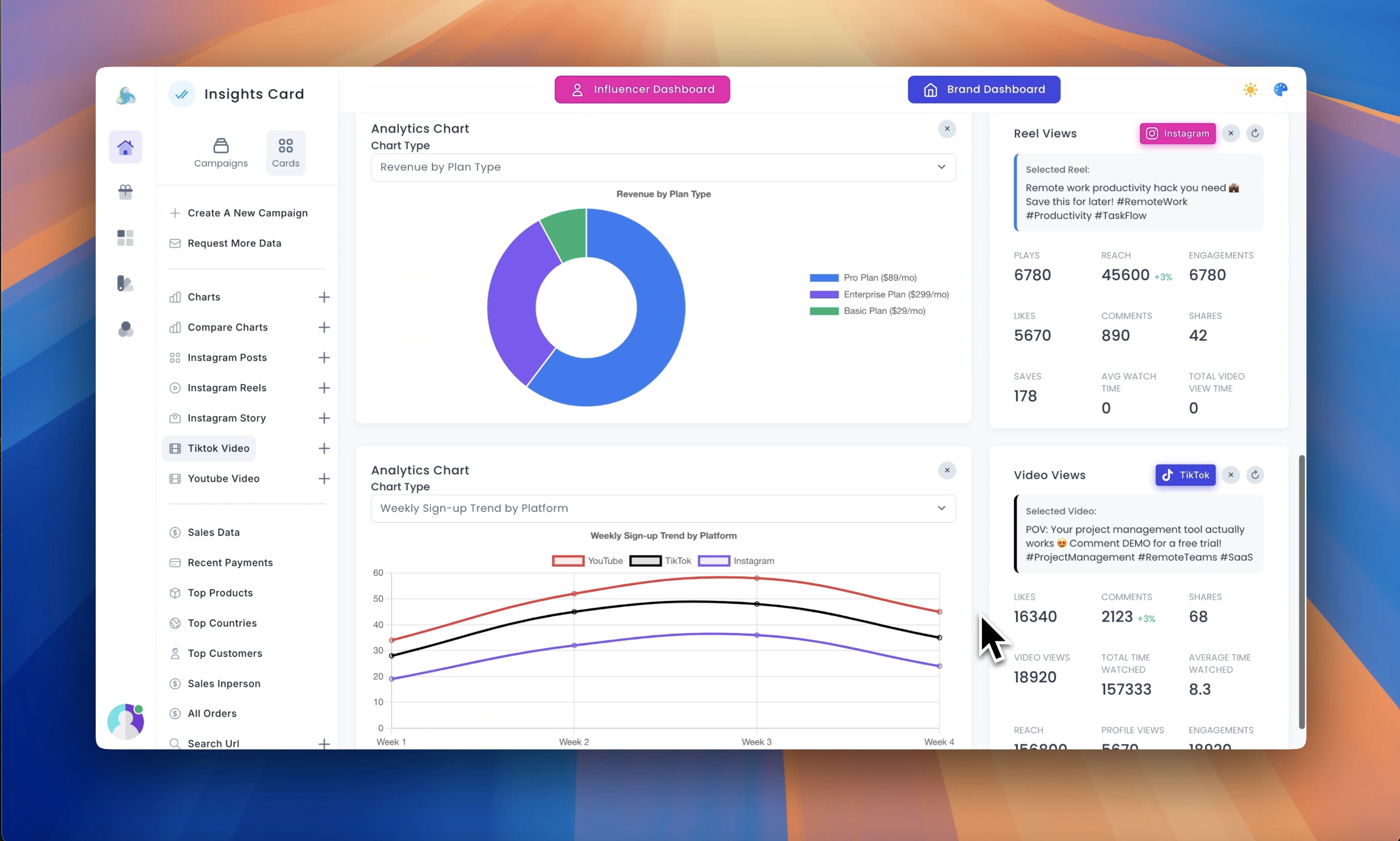
If you're a marketing agency owner or in-house marketer trying to prove which campaigns actually drive sales, you've probably hit a wall with Google Analytics 4.
The question keeps you up at night: "Did that influencer collaboration generate revenue, or was it just vanity metrics? Is my content marketing working, or am I burning budget?"
Here's the uncomfortable truth: Google Analytics 4 excels at tracking website behaviour, but it falls short when you need precise marketing attribution across the channels modern marketers actually use—influencer partnerships, organic social posts, in-person events, and content creator collaborations.
Let's break down the real differences between GA4 and purpose-built attribution software like Influmetrix, so you can make an informed decision about which tool will actually help you optimizs your marketing spend.
The Core Difference: What Each Tool Was Built For
Google Analytics 4 was designed to track website and app user behaviour. It tells you what people do once they're on your digital properties page views, session duration, bounce rates, and conversions that happen on your site.
Influmetrix was built specifically to solve the attribution problem that agencies and marketers face daily: connecting your diverse marketing activities—influencer posts, organic content, events, blog articles, and creator partnerships—directly to revenue and conversions.
Think of it this way: GA4 is like having a security camera inside your store that shows you what customers do once they walk in. Influmetrix is like having cameras on every street corner showing you exactly which billboard, which conversation, or which flyer brought them to your store in the first place.
Where Google Analytics 4 Struggles with Modern Marketing Attribution
1. Impression-Led Channels Are Invisible
GA4 only tracks clicks and direct website sessions. This creates a massive blind spot for impression-based marketing—the very channels that build awareness and influence buyer decisions.
When someone sees your Instagram post, watches your TikTok video, or notices your brand at an event but doesn't immediately click through, GA4 records nothing. Days later, when that person searches for your brand and converts, GA4 credits "direct traffic" or "branded search"—completely missing the original touchpoint that sparked their interest.
For agencies running influencer campaigns or content marketing strategies, this is catastrophic. You're essentially flying blind on whether your top-of-funnel efforts work at all.
2. Multi-Touch Attribution Is Limited and Opaque
GA4 offers data-driven attribution (DDA), which sounds sophisticated but comes with serious limitations. The model requires at least 400 conversions per month to even function. If you're a growing agency or SMB marketer without massive traffic, you're stuck with last-click attribution by default—meaning the final touchpoint before conversion gets 100% of the credit.
Even when DDA does work, it's a black box. Google doesn't show you the formula or weightings it uses. You're trusting an algorithm you can't see or validate, making it nearly impossible to explain to stakeholders why certain channels get credited the way they do.
Additionally, GA4's data-driven model only considers up to 50 touch points maximum and uses a 90-day lookback window. For B2B agencies with longer sales cycles, this artificially shortens the customer journey and misses critical early-stage touch points.
3. Offline Conversions and Events Don't Exist
If you run in-person events, trade shows, networking meet-ups, or any offline marketing activity, GA4 offers no native way to track these efforts back to revenue. You're left manually importing data or using workarounds that break the attribution chain.
For music promotion companies, event marketing agencies, or brands that blend online and offline tactics, this makes GA4 fundamentally incomplete as an attribution solution.
4. Influencer and Creator Marketing Is Nearly Impossible to Track Accurately
When you partner with influencers or content creators, tracking their impact in GA4 becomes a tagging nightmare. You need to:
Create unique UTM parameters for every creator and every post
Hope they use your links correctly (they often don't)
Manually track stories and non-clickable content separately
Try to attribute the brand lift from their audience seeing your product
Most agencies end up with incomplete data, resort to vanity metrics like "impressions" and "engagement," and struggle to justify ROI to clients or leadership.
5. Cross-Device and Cross-Platform Tracking Has Major Gaps
GA4's cross-device tracking relies on Google Signals, which only works when users are signed into their Google accounts across all devices. In reality, most customer journeys span logged-out mobile browsing, different devices, and platforms Google can't track—like TikTok, Snapchat, or offline interactions.
The result? GA4 often treats a single customer's journey as multiple separate users, fragmenting your attribution data and undervaluing channels that start journeys on mobile or social platforms.
6. Data Sampling Makes Large-Scale Analysis Unreliable
Once you exceed 500,000 sessions, GA4 begins using sampled data—meaning it estimates results based on a subset of your traffic rather than analysing everything. For agencies managing multiple client accounts or high-traffic brands, this introduces uncertainty into your most important business decisions.
When you're trying to prove to a client that your strategy is working, "estimated" isn't good enough.
What Influmetrix Does Differently
Influmetrix was built from the ground up to solve the attribution challenges that GA4 can't address. Here's how:
1. Multi-Channel Attribution That Includes Your Actual Marketing Mix
Influmetrix tracks the channels modern marketers actually use:
Influencer and creator partnerships
: Automatically track which collaborations drive conversions, even when users don't click links immediately
Organic social posts
: See which of your LinkedIn posts, Instagram content, or TikTok videos lead to pipeline and revenue
Blog content and SEO
: Connect your content marketing efforts to actual customer acquisition
In-person events and offline marketing
: Capture the full picture by including event attendance, networking, and offline touchpoints
Email campaigns and newsletters
: Track beyond just open rates to see revenue impact
Instead of forcing you to choose between "website analytics" and "everything else you do," Influmetrix gives you one unified view of your entire marketing operation.
2. Transparent, Flexible Attribution Models You Can Actually Explain
Unlike GA4's opaque data-driven model, Influmetrix lets you choose and customize attribution models based on your specific business needs:
First-touch attribution
: Credit the channel that introduced customers to your brand
Last-touch attribution
: Focus on what closes deals
Multi-touch attribution
: Distribute credit across the entire customer journey
Custom weighted models
: Create your own rules based on what matters most to your business
Most importantly, you can see exactly how each model calculates attribution and easily explain it to clients, stakeholders, or your CFO. No more "the algorithm says so" conversations.
3. AI-Powered Insights That Tell You What's Actually Working
Influmetrix includes an AI marketing assistant that analyzes your data and surfaces actionable insights like:
"Your LinkedIn posts generate 3x more qualified leads than Instagram, but Instagram users have a 40% higher conversion rate"
"Event attendees who also engage with your content convert 5x faster than those who don't"
"This month's influencer partnership is underperforming—consider reallocating budget"
Instead of staring at dashboards trying to figure out what the numbers mean, you get plain-English recommendations you can act on immediately.
4. Built for Agencies and Teams Managing Multiple Campaigns
If you're an agency managing multiple clients or an enterprise marketing team running diverse campaigns simultaneously, Influmetrix's interface is designed for your workflow:
Client-specific dashboards
: Each client gets their own attribution view
Campaign-level tracking
: See performance by campaign, not just by channel
Real-time reporting
: Share live dashboards with clients instead of spending hours building PowerPoints
White-label options
: Present insights under your agency's branding
GA4 was built for a single brand tracking their own website. Influmetrix was built for the reality of modern marketing operations.
5. No Minimum Traffic Requirements or Data Sampling
Unlike GA4's data-driven attribution that requires 400+ monthly conversions, Influmetrix works from day one—even if you're just starting out or managing smaller accounts. And there's no data sampling, ever. Every conversion is tracked and analyzed completely, giving you confidence in your numbers regardless of traffic volume.
The Real-World Impact: A Practical Comparison
Let's say you're a marketing agency running campaigns for a fashion e-commerce client. Here's how attribution would look in each platform:
Scenario: A customer discovers your client through an influencer's Instagram story, later sees an organic LinkedIn post about a sale, receives a promotional email, and finally converts after clicking a Google ad.
In Google Analytics 4:
The Instagram story touchpoint? Not tracked (no click)
The LinkedIn post? Maybe tracked if they clicked, probably shows as "social" with no detail
The email? Tracked if UTM-tagged correctly
The Google ad? Gets 100% credit as the "last click"
Attribution result: GA4 says "Google Ads drove this sale"
In Influmetrix:
Instagram story tracked through unique tracking link and view-through attribution
LinkedIn post tracked with specific post-level data showing engagement and conversion path
Email tracked with full journey context
Google ad recognized as the final touchpoint
Attribution result: Influmetrix shows the complete customer journey across all four touchpoints, lets you choose how to weight each interaction, and gives credit appropriately across the channels that actually influenced the sale.
Now multiply this by hundreds of customers across multiple campaigns, and you can see why agencies who switch to specialized attribution software like Influmetrix finally understand what's actually driving results.
When Google Analytics 4 Makes Sense (And When It Doesn't)
To be fair, GA4 isn't useless—it's just designed for different needs.
Use GA4 when:
Your primary goal is understanding on-site behavior and user experience
You need deep integration with Google Ads for campaign optimization
You're tracking straightforward e-commerce with most traffic coming from paid search
You have a simple, mostly digital-only marketing mix
You want free website analytics with basic conversion tracking
Use Influmetrix when:
You need to prove ROI across influencer marketing, content, events, and organic social
You manage multiple clients or campaigns that require separate attribution views
Your customer journeys span multiple touchpoints and channels before conversion
You need transparent, explainable attribution models you can present to stakeholders
You're tired of seeing "direct traffic" get credit for conversions you know came from your marketing efforts
You want AI-powered insights, not just raw data
The Bottom Line: Stop Guessing, Start Knowing
Here's what it comes down to: If you're serious about understanding which marketing activities actually drive revenue—not just website visits—you need purpose-built attribution software.
Google Analytics 4 will tell you what happens on your website. Influmetrix tells you which marketing efforts brought people there and whether they're worth your investment.
For agencies billing clients based on results, for marketing teams defending their budgets to leadership, and for anyone running influencer partnerships, content strategies, or multi-channel campaigns, specialized attribution is no longer optional—it's essential.
The cost of not knowing is far higher than any software subscription. Every month you spend budget on strategies that aren't working, or cut spending on channels that are actually your secret weapon, you're leaving money on the table.
Ready to See Your Marketing Attribution Clearly?
If you've been frustrated by GA4's blind spots or tired of defending your marketing strategy with incomplete data, it's time to try Influmetrix.
We offer a 30-day free trial—no credit card required—so you can connect your marketing channels and see the full picture of what's actually driving conversions for your business.
Start your free trial today and discover which of your marketing efforts are your secret weapons, and which ones you can stop wasting budget on.
Frequently Asked Questions
Can I use Influmetrix alongside Google Analytics 4?
Yes, many of our customers use both. GA4 handles website behavior and user experience analytics, while Influmetrix tracks marketing attribution across all your campaigns and channels. They complement each other rather than compete.
How does Influmetrix track influencer and creator marketing?
Influmetrix uses a combination of unique tracking links, view-through attribution technology, and API integrations with social platforms to capture both direct clicks and indirect brand influence from influencer partnerships.
What if I have low traffic or conversions? Will attribution still work?
Absolutely. Unlike GA4's data-driven attribution that requires 400+ monthly conversions, Influmetrix works from day one with any traffic volume. Our models don't require minimum thresholds to provide accurate attribution.
How long does it take to set up?
Most customers are up and running within 30 minutes. You'll connect your marketing channels (social media accounts, email platform, CRM, etc.), and Influmetrix begins tracking immediately. Our AI assistant helps you set up attribution models tailored to your business.
Do you integrate with the tools I already use?
Influmetrix integrates with 50+ marketing platforms including Shopify, HubSpot, Mailchimp, LinkedIn, Instagram, TikTok, WordPress, and more. If you need a custom integration, our team can typically build it within days.
What's the learning curve like?
Our interface is designed for marketers, not data scientists. Most users are confidently running attribution reports within their first day. And our AI marketing assistant provides guidance and insights in plain English—no technical jargon required.
Ready to stop guessing and start knowing what marketing actually drives revenue? Start your 30-day free trial of Influmetrix today and see your complete marketing attribution picture within minutes.